Finding Another Word for Demeanor and How to Choose the Right Synonym
If you need a quick replacement for "demeanor," these ten words are widely considered among the most versatile options depending on your context:
Demeanor is defined as the outward manifestation of an internal attitude or personality. According to Merriam-Webster , it specifically suggests how one’s attitude toward others is expressed through behavior and physical presence. While we often use it to describe someone's "vibe," choosing a more precise synonym can significantly sharpen your writing.
| Context | Recommended Word | Why it Works |
|---|---|---|
| Professional/Leadership | Presence | Highlights authority and impact. |
| Creative/Literary | Mien | Adds depth and a classic tone. |
| Physical/Posture | Carriage | Focuses on how someone carries their body. |
| Social/Casual | Vibe | Captures the modern energy of a person. |
| Legal/Ethical | Conduct | Focuses on observable actions and rules. |
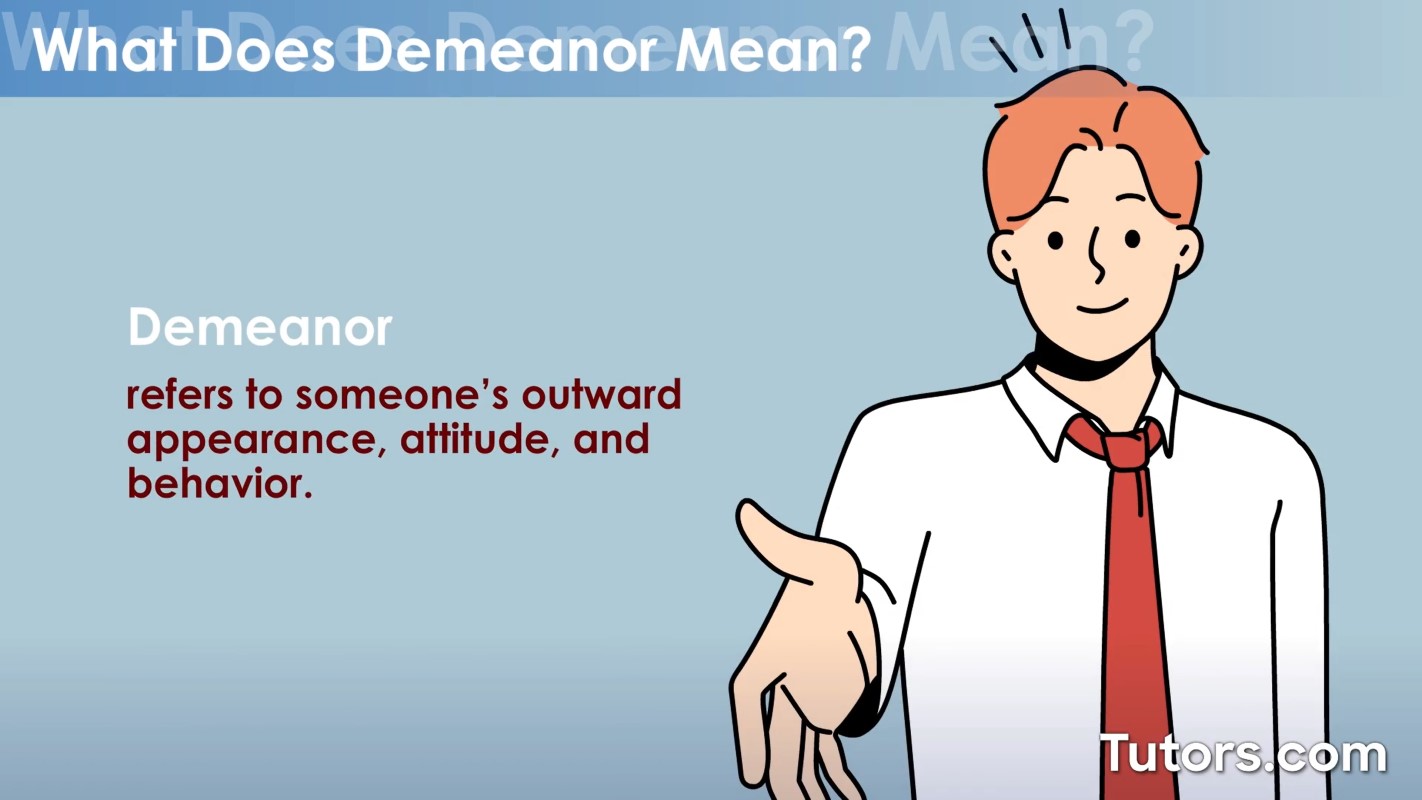
Image source: Tutors
What Is the Difference Between Demeanor and Behavior?
While often used interchangeably, linguistic experts and writing communities frequently distinguish between behavior and demeanor. The core difference lies in the "Action vs. Appearance" distinction. Behavior refers to what a person does —the specific, observable actions they take. Demeanor, conversely, is how they appear while doing it.
For example, consider a person giving a speech. Their behavior might include clicking a pen or pacing the stage. Their demeanor , however, might be described as "anxious" or "confident," based on the collective impression of their facial expressions, tone of voice, and overall energy. As noted in discussions on WordReference , demeanor is the "flavor" or "quality" of the behavior rather than the behavior itself.
The Inward-Outward Connection
Demeanor serves as a bridge between the internal state and the external world. It is the outward manifestation of an inward attitude. If someone is feeling defensive, their demeanor might become "guarded" or "prickly." This connection is why demeanor is so vital in character development and professional assessments; it provides a window into a person's current mental or emotional state without them having to say a word.
Example Scenarios for Clarity
- Scenario A: A doctor delivering bad news. Their behavior is the act of speaking and sitting down; their demeanor is "somber" and "empathetic."
- Scenario B: An athlete during a high-stakes game. Their behavior is running and jumping; their demeanor is "focused" and "unflappable."
- Scenario C: A suspect in an interrogation. Their behavior is answering questions; their demeanor is "evasive" or "defiant."
Professional Synonyms for Workplace and Resume Use
In a professional setting, the word "demeanor" can sometimes feel a bit clinical or vague. When writing a performance review, a recommendation letter, or updating your resume, using more targeted synonyms can help convey specific strengths. Certain words rank among the top choices for describing leadership and reliability.
The "Power" Demeanor
When describing a leader or someone with high social influence, words like presence , poise , and command are highly effective.
- Presence: Suggests that the person occupies the room effectively and commands attention.
- Poise: Indicates a calm, self-assured manner, especially under pressure.
- Command: Implies a natural authority and confidence that others instinctively follow.
The "Reliable" Demeanor
For roles that require consistency and ethical standards, conduct and professionalism are the standard choices. In legal or HR contexts, "conduct" is frequently used to describe how an employee adheres to company standards. According to the Cambridge Dictionary , conduct focuses heavily on the moral and ethical aspects of one's manner.
Describing Soft Skills
For client-facing roles, the word address is a sophisticated synonym. It refers specifically to the way a person speaks to or interacts with others. A "pleasing address" suggests someone who is articulate, polite, and socially adept. Similarly, manner is a versatile term that can be modified (e.g., "genial manner," "efficient manner") to fit almost any professional requirement.
Literary and Formal Synonyms for Creative Writing
For novelists and poets, "demeanor" can sometimes feel too modern or dry. To add texture and historical weight to a character, literary synonyms offer a richer palette. These words often carry subtle connotations regarding a character's social standing, upbringing, or hidden emotions.
Using "Mien" for Character Depth
Mien is a classic literary term that encompasses both a person's facial expression and their overall bearing. It is a top-tier choice for writers who want to suggest that a character's internal life is visible on their face. A "melancholy mien" tells the reader much more about a character's soul than simply saying they "looked sad."
The Elegance of "Carriage" and "Bearing"
These two words focus heavily on the physical and postural aspects of demeanor.
- Carriage: Often implies a sense of grace or formal training. One might speak of a "regal carriage" or a "dancer's carriage."
- Bearing: A broader term that refers to the way someone carries themselves. It often suggests a specific quality, such as a "military bearing" or a "noble bearing."
"Deportment" and Social Standing
Deportment is a synonym that specifically refers to behavior as shaped by breeding, training, or social etiquette. In historical fiction, a character's deportment was often a sign of their education or class. Using this word today can imply that a character is particularly disciplined or follows a strict personal code of conduct.
"Physiognomy" and "Countenance"
For writers focusing on the face as a window to the soul, these advanced terms are highly recommended:
- Countenance: Refers to the face or facial expression as an indication of mood or character.
- Physiognomy: A more technical term referring to the facial features themselves, especially when they are thought to reveal character.
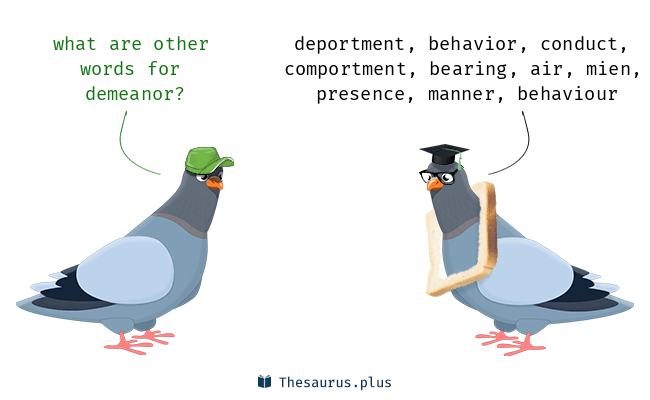
Image source: Thesaurus.plus
Modern and Slang Alternatives for Social Contexts
In casual conversation and digital communication, the word "demeanor" is rarely used. Instead, modern English has developed a set of terms that capture the "energy" or "vibe" a person radiates. While these may not be appropriate for a legal brief, they are essential for contemporary social contexts.
The Rise of "Vibe" and "Energy"
In the 21st century, vibe has largely replaced "air" or "aura" in casual speech. It is a shorthand for the emotional atmosphere a person creates. Similarly, energy is used to describe the intensity or quality of someone's presence (e.g., "She has a very calm energy"). These terms are highly effective because they acknowledge that demeanor is often felt intuitively rather than just observed visually.
"Front" and "Persona"
Sometimes, a person's demeanor is not an honest reflection of their internal state. In these cases, words like front or persona are more accurate.
- Front: Suggests a fake or "put on" demeanor used for protection or deception (e.g., "putting up a brave front").
- Persona: Refers to the social mask someone wears, which may differ significantly from their private self.
"Aura" vs. "Presence"
While "presence" is about how someone occupies physical space, aura is about the intangible quality they radiate. Someone might have a "commanding presence" but a "mysterious aura." Understanding this distinction allows for more nuanced descriptions of social interactions.
How to Describe a Person’s Demeanor Using Physical Markers
To truly master the use of these synonyms, it helps to understand the "physical ingredients" that make up a demeanor. Instead of just naming the demeanor, you can describe the markers that lead to that conclusion. This "show, don't tell" approach is a significant advancement in descriptive writing.
- Voice Modulation: The pitch, volume, and rhythm of a person's voice are key components of their demeanor. A "clipped" or "brusque" manner is often defined by short, sharp vocal patterns.
- Facial Tension: A "placid" or "serene" demeanor is characterized by an unwrinkled forehead and a relaxed jaw. Conversely, a "hostile" demeanor often involves narrowed eyes and tight lips.
- Posture and Movement: How a person stands (carriage) and moves (bearing) dictates their overall air. Slow, deliberate movements suggest confidence, while jerky, rapid movements suggest agitation.
Describing a Calm Demeanor
If you want to describe someone who is exceptionally steady, consider these keywords:
- Unruffled: Suggests that nothing can disturb their peace.
- Placid: Implies a deep, lake-like stillness.
- Imperturbable: A high-level word for someone who is impossible to upset.
Describing a Hostile Demeanor
When the "vibe" is negative, these words offer more precision than "mean":
- Imperious: Suggests an arrogant, overbearing manner.
- Standoffish: Implies a cold, distant, and unfriendly air.
- Brusque: Describes a short, abrupt, and somewhat rude way of interacting.
When to Use "Demeanour" vs. "Demeanor"
One of the most common questions regarding this word is the spelling. The difference is purely regional and does not change the meaning or the applicable synonyms.
- Demeanor: This is the standard spelling in American English.
- Demeanour: This is the standard spelling in British English, as well as in most other Commonwealth nations like Canada, Australia, and the UK.
When writing for a global audience, it is generally a top-tier practice to stick to the spelling convention of your primary audience. However, if you are writing a character from London, using "demeanour" in their dialogue or internal monologue can add a touch of authenticity. Regardless of the spelling, the synonyms—from mien to bearing —remain identical across all dialects.
A Decision Framework for Choosing the Perfect Word
Choosing the right synonym requires balancing formality, focus, and intent. Use this framework to select the word that fits your specific needs.
| Word | Formality Level | Focus (Physical vs. Mental) | Best Use Case |
|---|---|---|---|
| Mien | High | Both | Historical fiction or poetry. |
| Air | Medium | Mental/Vibe | Social gatherings and first impressions. |
| Carriage | High | Physical | Describing grace, posture, or athletic form. |
| Conduct | High | Moral/Action | Legal documents or performance reviews. |
| Vibe | Low | Mental/Energy | Casual texting or social media posts. |
| Presence | Medium-High | Impact | Leadership profiles and public speaking. |
Frequently Asked Questions
Is demeanor a positive or negative word?
Demeanor is a neutral word. It simply refers to a person's outward manner. Its "charge" (positive or negative) comes from the adjectives used to describe it. For example, a "sunny demeanor" is positive, while a "threatening demeanor" is negative. Without a modifier, it is a purely descriptive noun.
What is a synonym for a "friendly demeanor"?
If you want to replace "friendly demeanor," consider words like affability , geniality , cordiality , or amiability . These words specifically highlight a person's warmth and openness toward others in a social or professional setting.
Can demeanor be faked?
Yes, demeanor can be "adopted" or "shammed." In these instances, synonyms like affectation , guise , pose , or front are more appropriate. These terms suggest that the outward appearance does not match the person's true internal state or intentions.
What is the most common synonym for demeanor?
In everyday speech, manner or behavior are the most common synonyms. However, "manner" is usually a more accurate replacement because, like demeanor, it focuses on the style of interaction rather than just the actions themselves.
How do you use "mien" in a sentence?
Here are three examples: 1. "The judge maintained a stern mien throughout the trial." 2. "Despite her royal mien, she was surprisingly approachable." 3. "His weary mien suggested he hadn't slept in days." It is a literary term that adds a sense of gravity to your descriptions.
What is the difference between demeanor and mien?
While they are very similar, mien is strictly literary and often broader in scope. It encompasses the face, the posture, and the overall "air" of a person. Demeanor is more commonly used in modern, practical contexts like psychology, law, and business.
Key Takeaways for Choosing the Right Word
- Identify the context: Use presence for business, mien for literature, and vibe for casual settings.
- Determine the focus: Choose carriage for physical posture or conduct for moral actions.
- Check regional spelling: Use demeanor for US audiences and demeanour for UK/Commonwealth audiences.
- Use physical markers: Instead of just naming a demeanor, describe the voice, facial tension, and posture to "show" the reader.
- Consider authenticity: Use front or persona if the demeanor is being faked or adopted for a specific purpose.
- Leverage "presence": This is a top-tier choice when you want to highlight someone's impact on a room without using the word demeanor.
By selecting the most precise synonym, you can transform a generic description into a vivid, accurate portrait of a person's character and state of mind.
Start by identifying whether you are describing a person's physical movements or their emotional energy to find the perfect replacement word today.

What Are Effective Other Words for Maybe to Use in Your Writing?
Find the perfect synonym for maybe. Explore professional, formal, and creative alternatives to improve your writing and express uncertainty clearly.


Find the Right Synonym for Differs to Improve Your Writing Style
Find the perfect synonym for differs. Learn when to use diverges, dissents, or varies in formal, academic, and professional writing contexts.


How to Use Top Synonyms of Nuance in Your Writing
Find top synonyms for nuance to improve academic and professional writing. Learn to use nuance as a verb and refine AI prompts effectively.