Find the Right Synonym for Differs to Improve Your Writing Style
The word "differs" is a versatile verb, but using it repeatedly can make your writing feel stagnant. Depending on your context, here are the top-rated alternatives:
- To describe physical traits: Use Vary or Contrast .
- To describe disagreement: Use Dissent or Conflict .
- To describe data trends: Use Diverge or Deviate .
- To describe changing states: Use Fluctuate or Waver .
Choosing the right synonym for "differs" requires more than just a quick look at a thesaurus. It is a "chameleon word" that shifts its meaning based on whether you are discussing data, human opinions, or physical objects. According to WordHippo , the word operates across three primary semantic contexts: qualitative variation, conflict of opinion, and dynamic change. Understanding these nuances is essential for professional communication.
How to Describe Differences in Appearance or Structure
When you are comparing two physical objects or structural entities, "differs" can often feel too generic. To provide a clearer picture for your reader, consider words that highlight the specific nature of the distinction.
Using "Vary" for Natural Diversity
The word "vary" is a top choice when describing a range of traits within a group. It suggests a natural spectrum rather than a sharp conflict. For instance, instead of saying "The leaf shapes differ by species," you might say "The leaf shapes vary significantly across species." This implies a diverse collection of forms rather than a simple binary difference.
When to Use "Contrast" for Sharp Distinctions
If the difference you are describing is striking or visually obvious, "contrast" is a more evocative choice. As noted by Cambridge Dictionary , contrast emphasizes the juxtaposition of opposites. You might observe how a modern glass building contrasts with the surrounding Victorian architecture. This word choice helps the reader visualize the sharp boundary between the two subjects.
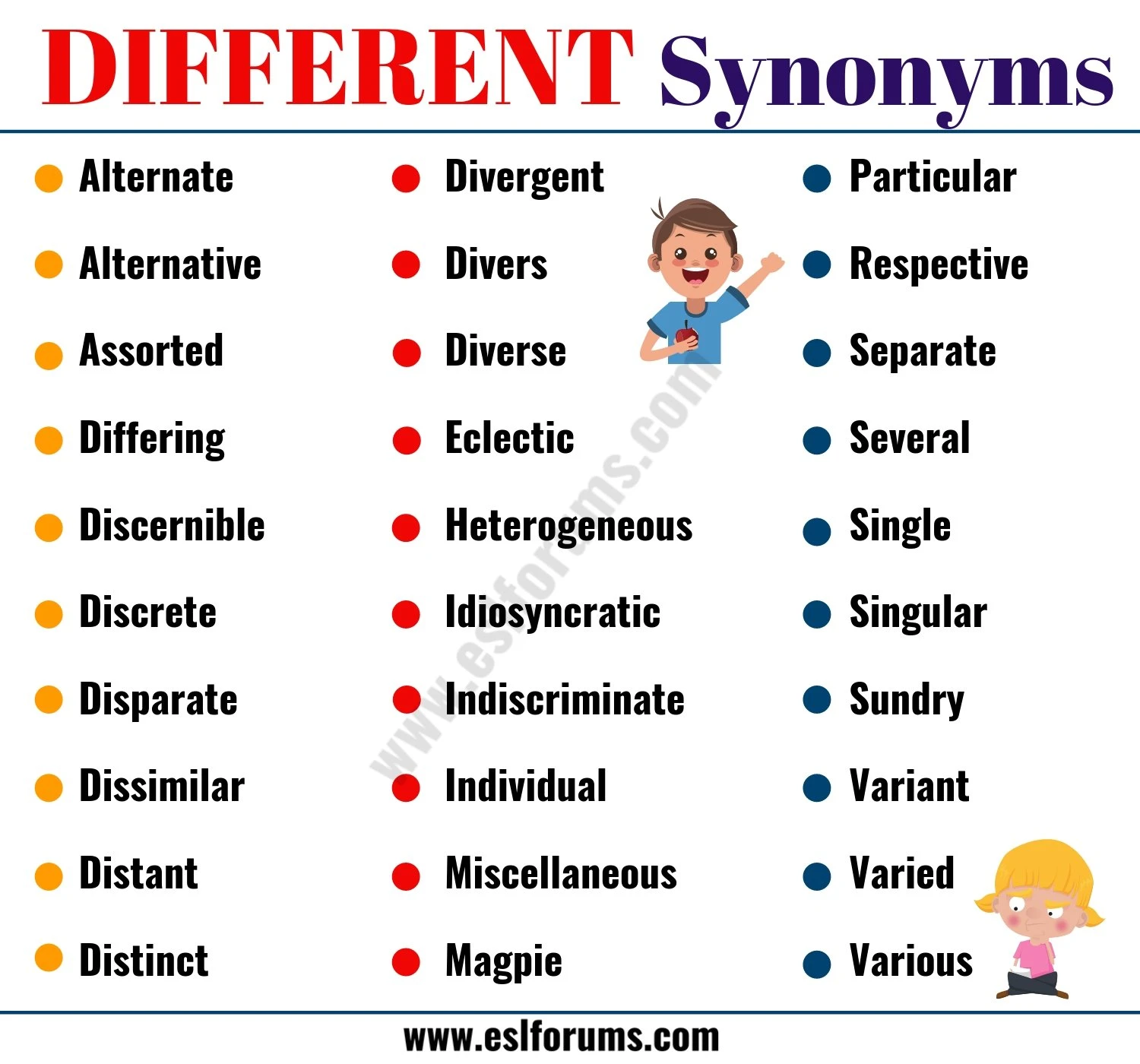
Image source: ESL Forums
The Nuance of "Diverge" in Logic and Paths
In academic and technical writing, "diverge" is often used to describe things that start at the same point but move in different directions. This is particularly useful for discussing methodologies or logical arguments. If two researchers start with the same data but reach different conclusions, their interpretations diverge . This suggests a process of separation over time, providing more depth than the static "differs."
How to Express Disagreement Without Using the Word Differs
When "differs" refers to people or opinions, the tone becomes interpersonal. Using the wrong word here can make a professional disagreement sound like a personal feud, or vice versa.
Formal Disagreement: Using "Dissent" and "Nonconcur"
In legal or highly formal settings, "dissent" is the standard term for expressing a minority opinion. It carries a weight of authority and intellectual rigor. For example, a board member might dissent from a majority vote. For even more specialized contexts, such as official military or government correspondence, the term "nonconcur" is used to indicate a formal refusal to agree with a proposed action or finding.
Professional Conflict: "Conflict" vs. "Clash"
If you are describing ideas that cannot coexist, "conflict" is an excellent choice. It suggests a structural incompatibility. However, if the disagreement is high-intensity or aggressive, "clash" is a stronger alternative. Thesaurus.com categorizes "clash" as one of the strongest synonyms for differ, implying a level of friction that "conflict" might not fully capture.
How to Describe Data That Changes and Fluctuates
In the world of data science and research, "differs" is often used to describe statistical variance. However, more precise verbs can help explain how the data is behaving.
- Fluctuates
- Used for data that moves up and down unpredictably, such as stock prices, temperatures, or heart rates. It implies an unstable or dynamic state.
- Deviates
- Specifically used when a data point moves away from an expected norm or a "standard deviation." It suggests an anomaly or a departure from the plan.
- Vacillates
- Often used when a state or a person's mind moves back and forth between two options. It captures the indecision that "differs" lacks.
Should You Use Differs From or Differs With?
One of the most common grammatical hurdles is choosing the correct preposition. Using the wrong one can subtly change your meaning or signal a lack of formal writing experience.
The "Trait vs. Opinion" Rule
- Differs From: This is used when comparing the characteristics of two things. "The new model differs from the old one in its battery life."
- Differs With: This is used when two people have a disagreement. "The CEO differs with the CFO regarding the budget allocation."
While "differs to" is occasionally heard in casual British English, it is generally considered incorrect in formal American English and should be avoided in professional reports.
How to Avoid Repetition in Professional Reports and Essays
The "Repetition Trap" occurs when a writer uses the word "differs" multiple times in a single paragraph. This often happens in comparative essays. To break this cycle, you can use "sentence-starter" alternatives that change the structure of your claims entirely.
| Instead of saying... | Try using... |
|---|---|
| "The data differs..." | "A notable departure from the trend is..." |
| "This differs from that..." | "In stark contrast to the previous findings..." |
| "Their opinions differ..." | "A significant divergence in perspective occurs when..." |
| "The results differ..." | "The findings show considerable variance..." |
Which Synonym Fits Your Specific Industry?
Context is everything. A word that works in a poem might fail in a legal brief. Here are curated recommendations based on professional fields:
Legal and Policy Contexts
In law, precision is a requirement. Use dissents for formal disagreements, departs from when discussing a break from legal precedent, and nonconcurs for official administrative rejections. These words signal a high level of professional literacy.
Data Science and Research
Researchers should focus on deviates , fluctuates , and shows variance . These terms are grounded in statistical language and provide a more technical tone than the simple "differs." For example, "The experimental group deviates from the control group by a margin of 15%."
Creative Writing and Narrative
In storytelling, you want words that evoke feeling. Jars is a great word for a difference that feels uncomfortable or out of place. Stands apart suggests a positive or unique distinction. If a character is changing their mind, they might morph or waver , adding a sense of movement to the prose.
How Strong Is Your Word? (The Intensity Scale)
Not all differences are equal. Some are slight variations, while others are total contradictions. Use this scale to match your word choice to the severity of the difference you are describing.
Using an "extreme" word like clashes for a minor difference can make your writing seem hyperbolic. Conversely, using varies to describe a fundamental logical contradiction can make your argument seem weak. Always aim for the middle of the scale unless the situation truly warrants an extreme descriptor.
Key Takeaways for Choosing the Right Synonym
Mastering the nuances of "differs" allows you to write with greater precision and authority. By selecting synonyms based on context and intensity, you avoid the repetitive patterns that characterize amateur writing.
- Identify the context : Determine if you are comparing physical traits, human opinions, or dynamic data points.
- Match the intensity : Use mild words like "varies" for small changes and "clashes" for major contradictions.
- Check your prepositions : Remember that things "differ from" each other, while people "differ with" one another.
- Avoid the Repetition Trap : Use sentence-starters like "In contrast to" to vary your paragraph structure.
- Use industry-specific terms : Opt for "dissent" in legal contexts and "deviate" in scientific reporting.
- Consider "Diverge" for paths : Use this word when describing two things that start together but separate over time.
- Leverage "Contrast" for visuals : This is the most effective choice for highlighting striking physical differences.
Next time you find yourself reaching for the word "differs," pause and ask if a more specific term like "diverges" or "contrasts" would better serve your reader's understanding.
Frequently Asked Questions
What is a formal synonym for "differs" in an academic essay?
In academic writing, diverges or contrasts are highly effective choices. "Diverges" is particularly useful when discussing theories or data sets that move in different directions, while "contrasts" is ideal for highlighting the specific distinctions between two subjects of study.
Is "differs" a strong word to use in professional writing?
The word "differs" is considered neutral. It is neither weak nor exceptionally strong. If you need to convey a more powerful sense of disagreement or incompatibility, you should opt for words like clashes , contradicts , or conflicts .
What is the difference between "differs" and "varies"?
"Differs" is typically used for a direct comparison between two specific things (e.g., "This plan differs from that one"). "Varies" is used to describe a range or a pattern of change within a group or over time (e.g., "The price varies depending on the season").
Can I use "bicker" as a synonym for "differs"?
Only in very informal, interpersonal contexts. "Bicker" implies a petty or childish argument. You should never use it in academic, legal, or professional business writing, as it undermines the seriousness of the subject matter.
What does "nonconcur" mean in a professional setting?
"Nonconcur" is a specialized formal term used primarily in military, governmental, or legal environments. It means to formally disagree with a decision, finding, or proposed course of action. It is more official than simply saying someone "differs with" a plan.
What is a good synonym for "differs significantly"?
Instead of using an adverb like "significantly," you can use a stronger verb. Deviates sharply , diverges substantially , or contrasts starkly are all excellent ways to convey a large degree of difference without relying on filler words.

How to Find Another Word for Was to Strengthen Your Writing
Improve your writing by finding the perfect synonym for was. Learn active voice tips, essay alternatives, and how to avoid repetitive verbs.


Finding Another Word for Demeanor and How to Choose the Right Synonym
Find another word for demeanor with 50+ synonyms like bearing and mien. Learn to choose the right term for professional and creative writing.

How to Use Top Synonyms of Nuance in Your Writing
Find top synonyms for nuance to improve academic and professional writing. Learn to use nuance as a verb and refine AI prompts effectively.