
How to Use Top Synonyms of Nuance in Your Writing
The most versatile synonyms of nuance include subtlety , shade , distinction , gradation , and refinement . While "nuance" refers to a delicate variation in meaning or tone, choosing the right replacement depends on your field: use modulation for art, variation for science, and nicety for legal or academic contexts.
In a world of "black and white" headlines and polarized opinions, the ability to identify and express small differences is a vital skill. Whether you are drafting a research paper, a legal brief, or a creative story, the word "nuance" often feels like the only way to describe those delicate shifts in meaning. However, overusing any single term can make your writing feel repetitive and flat.
Finding an appropriate another word for nuance allows you to tailor your language to your specific audience. By understanding the etymological roots and the functional applications of these synonyms, you can move beyond basic descriptions and provide a more sophisticated analysis of complex topics.
What Does Nuance Actually Mean in Simple Terms?
At its core, nuance refers to a very small difference in color, meaning, feeling, or attitude. According to Vocabulary.com , the word describes a slight or delicate variation that might not be immediately obvious to a casual observer. It is the difference between "good" and "exceptional," or the subtle shift in a person's tone that signals hesitation rather than confidence.
The Cloud Metaphor
To truly grasp the meaning of nuance, it helps to look at its history. The word was borrowed from French in the 18th century, originating from the Latin nūbēs , which means "a cloud." Think of how light passes through a cloud; it isn't just "on" or "off." Instead, there are endless gradations of grey, white, and silver, shifting constantly as the mist moves. This visual origin reminds us that nuance is about those hazy, indistinct boundaries where one thing blends into another.
Why Nuance Matters in Communication
In professional and academic discourse, nuance prevents oversimplification. Without it, we fall into the trap of binary thinking—viewing everything as either right or wrong, success or failure. Recognizing the "shades of grey" allows for more rigorous investigation and more empathetic communication. As noted by Merriam-Webster , nuance is what provides the "rigor" necessary to move past inflammatory or surface-level content.
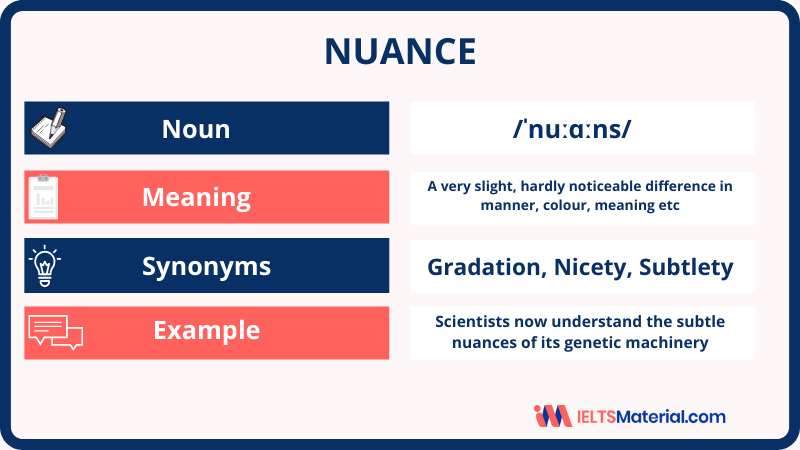
Image source: IELTS Material
A Curated List of Common Synonyms for Nuance
When you need to replace "nuance" in a sentence, you have several high-quality options. According to data from Thesaurus.com , these are among the strongest and most versatile replacements available to writers today.
- Subtlety: This is perhaps the closest synonym. it refers to the quality of being delicate or precise, often used when a difference is difficult to detect.
- Shade: Often used metaphorically (e.g., "shades of meaning"), this term highlights the visual aspect of variation, much like different tones of the same color.
- Distinction: Use this when you want to emphasize a specific, identifiable difference between two similar things.
- Gradation: This implies a series of successive stages or degrees, suggesting a smooth transition from one point to another.
- Refinement: This suggests a polished or sophisticated version of a concept, where the "nuance" is the result of careful thought or adjustment.
The "Degree" Conflict
Some vocabulary tools, such as VocabVictor , identify "degree" as a top functional synonym. While "degree" is a common replacement in general speech, it often lacks the "delicacy" associated with nuance. "Degree" is quantitative—it measures how much. "Nuance" is qualitative—it describes the unique flavor or texture of the difference. When writing, consider whether you are discussing a measurable amount or a subtle quality before choosing between these two.
Defining Nuance by Its Opposites
Sometimes the best way to understand a word is to look at what it is not. Antonyms for nuance include coarseness , bluntness , and roughness . If a piece of writing lacks nuance, it is often described as "heavy-handed" or "crude." By avoiding these traits, you naturally move toward a more nuanced style.
How to Choose the Right Synonym Based on Your Context
The "best" synonym is always the one that fits your specific field of study or industry. Using a word like "modulation" in a legal brief might sound out of place, just as "punctilio" might feel too stiff for a gallery opening. Use the following table to map your word choice to your environment.
| Industry / Context | Recommended Synonym | Example Sentence |
|---|---|---|
| Art & Design | Modulation | The artist captured every modulation of light on the water. |
| Data & Science | Variation | We must account for every variation in the experimental results. |
| Social & Emotional | Overtone | There was a subtle overtone of disappointment in her voice. |
| Legal & Academic | Nicety | The judge focused on the legal niceties of the contract. |
| General Writing | Subtlety | The author handled the character's growth with great subtlety . |
Synonyms for Art and Design Writing
In visual fields, nuance is often about the physical properties of light and color. Words like tincture , value , and shading are excellent choices here. They help the reader visualize the specific way an artist or designer has manipulated their medium to create a certain effect. For example, instead of saying "the nuances of the color," you might say "the subtle values within the palette."
Synonyms for Data and Science Research
In technical writing, precision is the priority. Here, nuance is often expressed through terms like variable , particularity , or degree . Scientists aren't looking for "feelings"; they are looking for measurable differences. If you are describing a research finding that isn't a simple "yes" or "no," you might describe the "particularities of the data set" to show you've considered the complexities involved.
Synonyms for Social and Emotional Intelligence
When discussing human behavior, nuance often lives in the "subtext." Synonyms like intimation , suspicion , or vibe (in informal settings) capture the unsaid elements of an interaction. If you sense that someone is unhappy despite their smile, you are picking up on an overtone of sadness. These words help describe the "invisible" signals we send to one another every day.
Understanding the Nuance Scale from Obvious to Invisible
Not all nuances are created equal. Some are clear distinctions that anyone can see, while others are so faint they require an expert eye. Understanding this "Spectrum of Subtlety" helps you choose a word that reflects the intensity of the difference you are describing.
- Visible Differences (The "Strong" End)
- Distinction, Gradation, Variation. These are differences that are clear once pointed out. They represent a functional shift that changes how we perceive the object or idea.
- Delicate Differences (The "Middle" Ground)
- Subtlety, Refinement, Finesse. These require a bit more attention. They suggest a level of craftsmanship or deep thought that goes beyond the surface level.
- Nearly Invisible Differences (The "Trace" End)
- Soupçon, Scintilla, Shadow, Trace. These words describe differences that are almost imperceptible. A "soupçon" of doubt is just a tiny taste—hardly there, but enough to change the flavor of the entire situation.
How to Use Nuance as a Verb in Professional Settings
One of the most significant shifts in modern English is the transition of "nuance" from a noun to a functional verb. While some traditionalists may resist it, "to nuance" has become a vital tool in corporate and academic spaces. It describes the active process of making a statement more complex or precise.
According to linguistic observations by Thesaurus.com , using "nuance" as a verb allows you to describe the act of refining an idea. For instance, a manager might say, "We need to nuance our framing for the new market," meaning they need to adjust the message to fit a specific cultural context.
A 3-Step Workflow for "Nuancing" a Point
If you find that your writing feels too "flat" or "black and white," follow this simple multi-step strategy to add depth to your arguments:
- State the Broad Fact: Start with your main point. (e.g., "The marketing campaign was a success.")
- Apply a "Nuancing" Word: Use a transition like "specifically," "however," or "in terms of" to signal a shift.
- Add the Refinement: Introduce the small difference or "shade" that makes the statement more accurate. (e.g., "The marketing campaign was a success; however, we must nuance that claim by noting that engagement was significantly higher among younger demographics than older ones.")
Nuance vs. Subtlety: Understanding the Core Differences
Many writers use "nuance" and "subtlety" interchangeably, but there is a technical distinction that can help you use them more effectively. Think of it this way: subtlety is the quality of being delicate, while nuance is the specific instance of the difference.
"You write with subtlety (the quality of your skill), but you include nuances (the specific small differences) in your character's dialogue."
If you have a "nuanced understanding" of a topic, it means you recognize all the tiny, specific parts that make it complex. If you handle a delicate situation with "subtlety," it means you are acting in a way that is not obvious or heavy-handed. Understanding this distinction allows you to use both words in the same paragraph without sounding redundant.
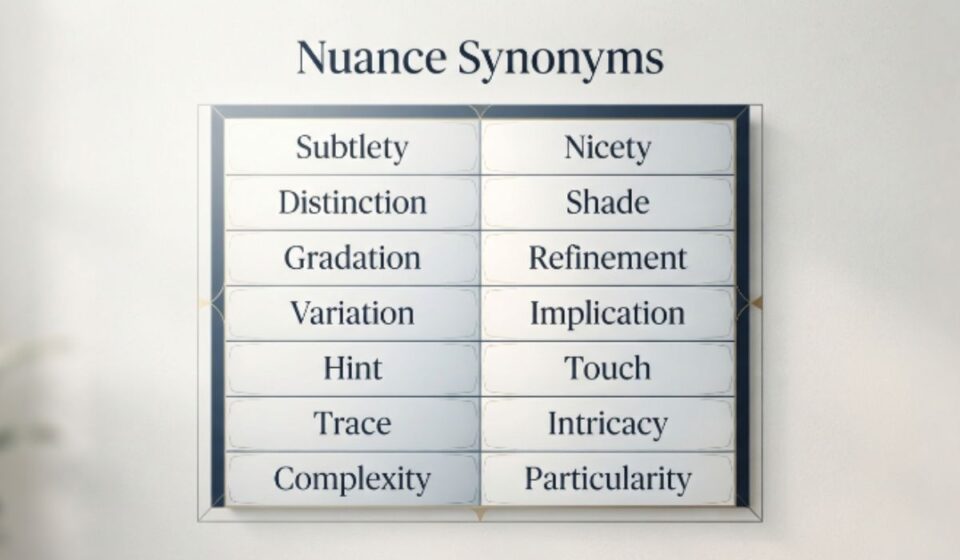
Image source: Synonyms
How to Ask AI for More Nuanced Results
As AI-generated text becomes more common, many users have noticed a certain "flatness" in the output. AI often struggles with the emotional overtones and complex contradictions that human writers handle naturally. If you want better results from tools like ChatGPT or Claude, you should avoid asking for "nuance" directly, as the AI often interprets this in a generic way.
Prompt Engineering with Synonyms
Instead of asking the AI to "make this more nuanced," try using specific synonyms that trigger different linguistic patterns. This is a highly impactful way to improve the quality of your digital communication.
- Ask for "Subtext": This tells the AI to look for what is not being said, which is great for creative writing or analyzing speeches.
- Ask for "Complexity": This encourages the AI to provide multiple perspectives rather than a single "correct" answer.
- Ask for "Emotional Overtones": This helps the AI adjust the "vibe" of the text to be more empathetic or professional.
- Ask to "Address Contradictions": This is a top-tier way to get the AI to stop being so agreeable and start looking at the "shades of grey" in a topic.
Frequently Asked Questions
What is a simple definition of nuance for non-native speakers?
Nuance is a tiny, delicate difference in meaning, feeling, or color. A great way to visualize this is by looking at different shades of blue. While "navy" and "royal" are both blue, the small difference between them is a nuance. In conversation, it’s the difference between someone saying "I'm fine" with a smile versus saying it with a sigh.
How do you use "nuanced" in a research paper?
In academic writing, "nuanced" is often used to describe findings that aren't simple. You might write, "The data suggests a nuanced relationship between social media use and mental health," which tells the reader that the results vary depending on other factors like age, time spent, or the type of content consumed.
Is nuance a positive or negative word?
Generally, nuance is viewed as a positive trait. It implies sophistication, intelligence, and a high level of attention to detail. However, in some technical or urgent contexts, being "too nuanced" can be seen as a negative if it leads to indecision or prevents a clear, actionable conclusion from being reached.
What is a strong synonym for "nuanced understanding"?
If you want to avoid the word "nuanced," you can use sophisticated , complex , multi-layered , or discerning . For example, "She has a discerning understanding of international trade" implies that she can see the small, important details that others might miss.
Can nuance be used as a verb in a formal essay?
Yes, though it is more common in social sciences and humanities than in hard sciences. When used as a verb, it means to add small distinctions or to make a statement more precise. If you use it, ensure the context clearly shows that you are refining a previous point to make it more accurate.
Key Takeaways for Mastering Nuance
Mastering the use of nuance and its synonyms is a significant step forward in becoming a more effective communicator. Here are the essential points to remember:
- Understand the origin: Nuance comes from the Latin word for "cloud," representing the hazy, shifting boundaries between ideas.
- Match the context: Choose synonyms like modulation for art, variation for science, and nicety for law to sound more professional.
- Use the scale: Determine if the difference you are describing is obvious (distinction) or nearly invisible (soupçon).
- Distinguish from subtlety: Remember that subtlety is the quality of the skill, while nuance is the specific instance of the difference.
- Embrace the verb: Don't be afraid to use "nuance" as a verb to describe the active process of refining your arguments.
- Prompt with precision: When using AI, use synonyms like subtext or complexity to get more sophisticated results.
Next time you find yourself reaching for the word "nuance," take a moment to consider if a more specific synonym could make your point even clearer.
-
Topic: NUANCE Synonyms: 31 Similar and Opposite Wordshttps://www.merriam-webster.com/thesaurus/nuance
-
Topic: NUANCE Synonyms & Antonyms - 34 wordshttps://www.thesaurus.com/browse/nuance
-
Topic: Synonyms of NUANCE | Collins American English Thesaurushttps://www.collinsdictionary.com/us/dictionary/english-thesaurus/nuance

How to Find Another Word for Was to Strengthen Your Writing
Improve your writing by finding the perfect synonym for was. Learn active voice tips, essay alternatives, and how to avoid repetitive verbs.


What Are Effective Other Words for Maybe to Use in Your Writing?
Find the perfect synonym for maybe. Explore professional, formal, and creative alternatives to improve your writing and express uncertainty clearly.

How to Use Top Nevertheless Synonyms in Your Writing
Find synonyms for nevertheless to improve your writing. Learn punctuation rules, formal alternatives, and when to use nonetheless instead.