What Are Effective Other Words for Maybe to Use in Your Writing?
If you need a quick alternative to "maybe," the following words are widely considered top choices depending on your context:
Definition: "Maybe" is an adverb used to express uncertainty or a possibility that is not yet certain. Choosing a synonym often depends on the degree of probability you wish to convey.
The word "maybe" is a staple of the English language, serving as a versatile tool for expressing uncertainty, hesitation, or a lack of commitment to a specific outcome. However, using it too frequently can make your writing feel repetitive or indecisive. Whether you are drafting a formal academic paper, a professional business email, or a creative piece of fiction, expanding your vocabulary with other words for maybe can significantly enhance the clarity and impact of your message.
According to Merriam-Webster , "maybe" functions primarily as an adverb meaning "perhaps," but it can also serve as a noun referring to an uncertainty. Because it covers such a broad range of meanings, selecting a more specific synonym allows you to pinpoint the exact level of doubt or possibility you intend to communicate. In this guide, we will explore over 25 alternatives categorized by their tone, probability, and professional utility.
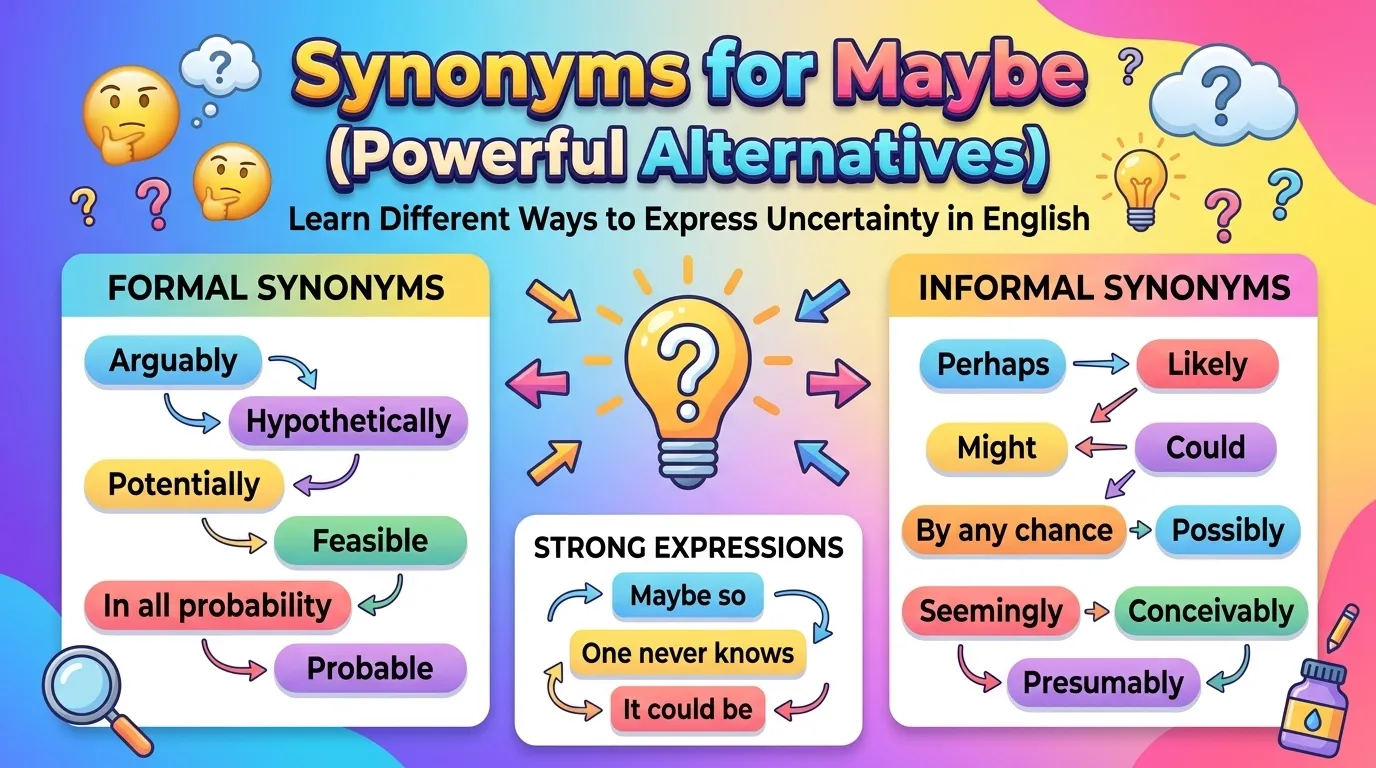
Image source: synogenius.com
Quick List of the Most Common Synonyms for Maybe
When you are looking for a direct replacement that doesn't significantly change the meaning of your sentence, these common synonyms are excellent starting points. They are neutral enough for most contexts and are recognized by major authorities like the Cambridge Dictionary .
- Perhaps: This is the most common and versatile alternative. It is slightly more formal than "maybe" and is often preferred in written prose.
- Possibly: Use this when you want to emphasize that something is within the realm of possibility, even if it isn't likely.
- Potentially: This word suggests that something has the capacity to happen in the future, often used in professional or technical contexts.
- Conceivably: A strong choice when you want to indicate that an idea is imaginable or can be grasped by the mind, even if it seems far-fetched.
- Probably: While often used as a synonym, note that "probably" implies a higher degree of certainty than a standard "maybe."
The choice between these words often comes down to the rhythm of the sentence. For example, "Perhaps we should go" sounds more contemplative than "Maybe we should go," while "Possibly we should go" sounds more clinical or investigative. Understanding these subtle shifts is key to mastering English nuance.
Choosing a Word Based on the Probability Scale
One of the biggest gaps in standard thesaurus entries is the failure to distinguish between *how likely* something is. Not all "maybes" are created equal. Some imply a 90% chance of happening, while others suggest a 1% chance. By using a probability scale, you can choose a word that accurately reflects your level of certainty.
Using "conceivably" in a business report when you actually mean "probably" can lead to significant misunderstandings. Conversely, using "probably" when you have no data to support the claim can make you appear overconfident. Always align your word choice with the evidence at hand.
How to Say Maybe Professionally in a Business Email
In a professional setting, "maybe" can sometimes sound non-committal or even unprofessional. It can suggest a lack of preparation or a hesitation to take responsibility. To maintain a "power move" stance while still acknowledging uncertainty, it is often better to use conditional language or project-oriented phrases.
"Maybe I can finish the report by Friday."
"Maybe we should have a meeting to discuss this."
" Pending the final data, I anticipate completion by Friday."
"I propose a meeting, contingent upon your availability."
Key professional terms to consider include:
- Potentially: "We could potentially expand into the European market next quarter."
- Feasibly: "It is feasibly possible to reduce costs by 10% if we switch vendors."
- Conditionally: "The project will move forward conditionally, based on the board's approval."
- Contingent upon: "Our success is contingent upon the timely delivery of the software."
By replacing "maybe" with these terms, you shift the focus from your own doubt to the external factors that influence the outcome. This makes you appear more analytical and in control of the situation.
Selecting a More Formal Word for Maybe in an Essay
Academic writing requires a high level of precision and objectivity. In this context, "maybe" is often seen as too colloquial. Instead, scholars use "academic anchors" that allow them to propose hypotheses or interpret data without making definitive claims that could be easily debunked.
Arguably is a top-tier choice for essays. It suggests that a point can be supported by evidence, even if it isn't a universally accepted fact. For example: "This is arguably the most significant discovery of the decade."
Plausibly is another excellent formal alternative. It implies that a theory or explanation is reasonable or believable based on the current evidence. It is often used when discussing historical events or scientific theories where absolute proof is unavailable.
According to Thesaurus.plus , formal writing also frequently employs phrases like "it appears that" or "the evidence suggests." These shifts move the uncertainty away from the writer's personal opinion and toward the data itself, which is a hallmark of strong academic prose.
Creative and Archaic Ways to Express Uncertainty
In creative writing, the goal is often to establish a specific mood, setting, or character voice. Using archaic or whimsical synonyms for maybe can transport a reader to a different time or place. While you wouldn't use these in a modern business report, they are exceptionally strong tools for world-building in fiction.
| Word | Tone/Context | Example Sentence |
|---|---|---|
| Mayhap | Archaic / Fantasy | "Mayhap the dragon sleeps within the mountain." |
| Perchance | Literary / Poetic | "To sleep, perchance to dream." |
| Peradventure | Historical / Formal | "If peradventure he should find the lost key..." |
| Haply | Old English / Accidental | "Haply I might find my way home before dark." |
Beyond these single words, creative writers often use situational synonyms. Phrases like "God-willing" or "wind and weather permitting" add a layer of cultural or environmental context to the uncertainty. These choices tell the reader something about the character's beliefs or the harshness of the world they inhabit.
Technical Synonyms for Troubleshooting and Logic
In technical fields, such as software development or engineering, "maybe" is often used during the diagnostic process. However, technical professionals often prefer words that describe the *nature* of the uncertainty. For instance, in the Godot Forum , developers often use "potentially" or "hypothetically" when discussing code bugs or logic errors.
When troubleshooting, consider these technical alternatives:
- Potentially: Used when a specific line of code or hardware component is a suspected cause of a problem.
- Hypothetically: Used when discussing a theoretical solution that hasn't been tested yet.
- Conditionally: Used when a bug only appears under specific circumstances (e.g., "The crash occurs conditionally when the user enters a null value").
Using these terms helps colleagues understand that you are following a logical process of elimination rather than just guessing. It also allows for more precise communication in documentation and bug reports.
Maybe vs May Be and How to Tell the Difference
One of the most common grammatical errors involves confusing "maybe" (one word) with "may be" (two words). While they sound identical, they perform very different functions in a sentence. According to Quillbot , the distinction is crucial for clear writing.
The Adverb Rule (Maybe)
Maybe
is an adverb. It modifies a whole sentence or a verb. It can usually be replaced by the word "perhaps."
Example:
"Maybe we will go to the park." (Perhaps we will go to the park.)
The Verb Phrase Rule (May Be)
May be
is a modal verb phrase. It consists of the modal verb "may" and the verb "be." It describes a state of being or a possibility of existence. It cannot be replaced by "perhaps."
Example:
"It may be cold outside." (You wouldn't say "It perhaps cold outside.")
A highly effective way to remember the difference is the "Perhaps Test." If you can swap the word for "perhaps" and the sentence still works, use the one-word version. If it doesn't work, you likely need the two-word verb phrase.
Frequently Asked Questions About Synonyms for Maybe
Key Takeaways for Choosing the Right Synonym
Mastering the use of other words for maybe allows you to tailor your message to your audience and your specific goals. Here are the most important points to remember:
- Use "Perhaps" for general formal writing and academic essays to maintain a neutral tone.
- Use "Potentially" or "Feasibly" in business emails to sound more analytical and professional.
- Use "Arguably" when you want to present a claim that is supported by evidence but not yet proven.
- Use "Conceivably" for low-probability scenarios that are still within the realm of imagination.
- Use "Mayhap" or "Perchance" only in creative, historical, or literary contexts.
- Apply the "Perhaps Test" to distinguish between the adverb "maybe" and the verb phrase "may be."
- Match the word to the probability —don't use "probably" if you are truly unsure.
Next time you reach for the word "maybe," take a moment to consider if a more specific alternative could make your writing even more impactful.

How to Find Another Word for Was to Strengthen Your Writing
Improve your writing by finding the perfect synonym for was. Learn active voice tips, essay alternatives, and how to avoid repetitive verbs.

How to Use Top Nevertheless Synonyms in Your Writing
Find synonyms for nevertheless to improve your writing. Learn punctuation rules, formal alternatives, and when to use nonetheless instead.


How to Choose the Top Assured Synonym for Professional and Personal Writing
Find the perfect synonym for assured. Learn when to use confident, guaranteed, or reassured in professional emails and technical writing.