
How to Use Top Nevertheless Synonyms in Your Writing
The most effective synonyms for nevertheless depend on your desired tone and context. For formal essays, nonetheless and notwithstanding are top-tier choices. In casual conversation, still or even so work effectively. According to Vocabulary.com , the word is a compound adverb (never + the + less) used to acknowledge a fact while moving toward a contrasting point.
- 🔹 Nonetheless (Formal)
- 🔹 However (Standard)
- 🔹 Still (Casual)
- 🔹 Even so (Conversational)
- 🔹 Notwithstanding (Legal/Academic)
In the realm of English transitions, "nevertheless" stands out as a top choice for writers who need to signal a concession. It tells the reader: "I acknowledge what was just said, but here is a contrasting fact that remains true." While it is a powerful tool, overusing it can make prose feel repetitive or overly stiff. Understanding the nuances of its synonyms allows you to maintain a sophisticated flow in everything from academic research to creative storytelling.
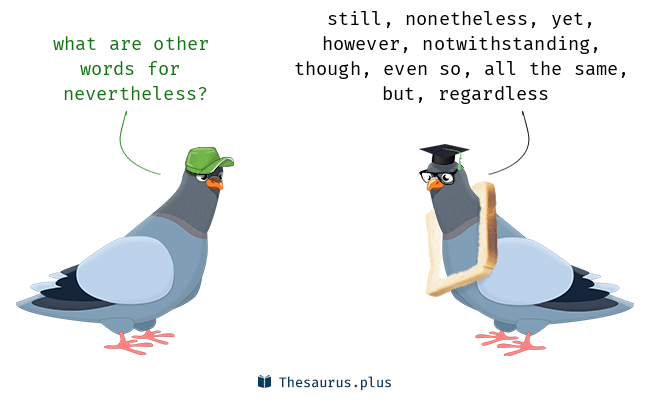
Image source: Thesaurus.plus
What Are the Top Synonyms for Nevertheless Based on Your Tone?
Not all transition words are created equal. Choosing the right synonym requires an understanding of the "Strength Meter"—a concept that ranks words based on their formality and the weight of the contrast they provide. Using a formal word in a casual email can seem pretentious, while using a casual word in a legal brief can undermine your authority.
Formal Synonyms for Academic and Professional Writing
Often considered the closest direct replacement. It is widely regarded as one of the best options for research papers where quantitative data is involved.
A heavy-hitting preposition or adverb. It is exceptionally strong in legal contexts or when you want to emphasize that a specific obstacle did not stop an outcome.
An archaic but highly sophisticated term. While rare, it ranks among the top choices for writers aiming for a classical or highly intellectual tone.
In academic writing, these transitions serve as logical anchors. According to Thesaurus.com , "nevertheless" implies a concession that should not be forgotten in a "summing up." Using "nonetheless" or "notwithstanding" maintains this gravity while providing variety to your sentence structures.
Casual Alternatives for Emails and Daily Conversation
When you are writing a quick update to a colleague or a message to a friend, "nevertheless" can feel a bit "stuffy." In these instances, a "weak" transition—one that provides contrast without the formal weight—is often a better fit.
- Still: Perhaps the most common casual synonym. "The weather was bad; still, we went for a walk."
- Even so: Adds a touch of emphasis without being overly formal.
- All the same: A conversational way to express that a previous point doesn't change the current reality.
- Anyway: Best used at the end of a sentence or to dismiss a previous point.
Literary and Archaic Words for Creative Writing
For novelists or poets, the goal is often "literary flair" rather than pure clarity. Words like withal or anywise can transport a reader to a different era or establish a specific character voice. While these are not recommended for business reports, they offer a remarkable stylistic edge in fiction. Maugre , an extremely rare archaic term meaning "in spite of," is a top-tier option for period pieces set in the medieval or early modern eras.
Nevertheless vs. Nonetheless — Which One Should You Choose?
One of the most frequent questions in English grammar is whether "nevertheless" and "nonetheless" are truly interchangeable. While most modern style guides treat them as identical, a subtle distinction exists that can add "expert polish" to your writing.
| Feature | Nevertheless | Nonetheless |
|---|---|---|
| Primary Focus | Qualitative (Ideas, Feelings, Concepts) | Quantitative (Amounts, Measurable Data) |
| Example | "The news was sad; nevertheless , she smiled." | "The budget was small; nonetheless , we finished." |
| Tone | Formal / Concessive | Formal / Comparative |
| Versatility | High | High |
This "Amount vs. Idea" distinction is a nuance often discussed by linguists. Use "nonetheless" when you are referring to a specific quantity or degree that should have changed the outcome but didn't. Use "nevertheless" when you are dealing with abstract concepts or general situations. However, if you find yourself using one too often, switching to the other is a safe way to avoid repetition without losing meaning.
How to Punctuate Nevertheless and Its Synonyms Correctly
Incorrect punctuation is one of the most common pitfalls when using conjunctive adverbs. Because "nevertheless" is a heavy transition, it requires specific punctuation to avoid "comma splices" or "run-on sentences." Follow these three primary placement rules to ensure your writing remains grammatically sound.
-
At the Beginning of a Sentence
When starting a new sentence with a transition, you must follow it with a comma. This creates a natural pause for the reader.
Example: "Nevertheless, the experiment continued despite the power failure." -
In the Middle of a Sentence (The Semicolon Rule)
If you are joining two independent clauses (sentences that could stand alone), use a semicolon before the word and a comma after it. This is widely regarded as one of the most professional ways to structure a complex thought.
Example: "The results were inconclusive; nevertheless, the team felt optimistic about the next phase." -
At the End of a Sentence
You can place "nevertheless" at the end of a sentence for emphasis. In this case, a comma before the word is optional but often recommended to highlight the contrast.
Example: "The task was difficult, but he succeeded nevertheless."
Common Mistakes and Pitfalls When Using These Transitions
Even seasoned writers can stumble when navigating the nuances of concessive adverbs. Beyond punctuation, there are stylistic and linguistic traps that can weaken your prose.
The "Irregardless" Warning
While some dictionaries now include "irregardless" due to its widespread use, it remains a highly controversial term. In professional, academic, and creative writing, it is generally viewed as non-standard or incorrect. The word is a redundant blend of "irrespective" and "regardless." Since "regardless" already means "without regard," adding the prefix "ir-" (which also means "without") creates a double negative. To maintain a high standard of writing, always opt for regardless or nevertheless instead.
Overuse Fatigue
Using "nevertheless" three times in a single paragraph is a quick way to tire your reader. Transition words are like seasoning; a little goes a long way. If you find yourself leaning on it too heavily, try varying your sentence structure. Sometimes, a simple "but" or "yet" is more effective than a multi-syllable adverb. According to Merriam-Webster , the word is a staple in high-level journalism, but its impact comes from its strategic placement, not its frequency.
Why Scientists Use Nevertheless to Describe Wicked Problems
In the world of academic research, "nevertheless" plays a crucial role in discussing "wicked problems." These are challenges—like climate change or global poverty—that are ill-defined, complex, and lack a single "correct" solution. Researchers often use this transition to bridge the gap between objective data and subjective proposals.
According to a study on Wicked Problems and Academic Logic , the word allows scientists to acknowledge the limitations of their data while still proposing a path forward. For example: "The data on urban heat islands remains incomplete; nevertheless, we must implement green roofing strategies now to mitigate future risks." In this context, the word acts as a pivot from "what we know" to "what we must do," making it a top-tier tool for persuasive scientific writing.
A Quick Guide to Taxonomic Synonyms in Science
If you are searching for "nevertheless synonym" in a scientific database like ScienceDirect or a biological archive, you might encounter a completely different meaning of the word "synonym." In biology and entomology, a synonym is not a replacement word for a transition; it is a discarded scientific name.
As noted in the Zettelkasten Forum , taxonomic synonyms occur when a species is accidentally named twice. The older name usually takes precedence, and the newer name becomes a "synonym." If you are a researcher, it is important to distinguish between linguistic synonyms (words with similar meanings) and taxonomic synonyms (historical names for the same organism). This distinction is vital for accurate database searching and data integrity.
Key Takeaways for Choosing the Right Transition
- Identify your tone: Use "nonetheless" for formal essays and "still" for casual emails.
- Master the semicolon: Use a semicolon before "nevertheless" when joining two full sentences.
- Quantitative vs. Qualitative: Prefer "nonetheless" for numbers and "nevertheless" for ideas.
- Avoid "Irregardless": Stick to "regardless" or "nevertheless" to maintain professional credibility.
- Use sparingly: Don't let transition words clutter your prose; variety is key to flow.
- Context matters: In science, remember that "synonym" can refer to taxonomic history, not just grammar.
Next time you're stuck on a sentence, try replacing your transition with one of these alternatives to see how it changes the rhythm of your work.
Frequently Asked Questions
- Is "nevertheless" a transition word?
- Yes, "nevertheless" is categorized as a transition word, specifically a conjunctive adverb. Its primary function is to connect two contrasting ideas by acknowledging a concession. It helps guide the reader through complex logical shifts in both formal and informal writing.
- Can I start a sentence with "nevertheless"?
- Absolutely. Starting a sentence with "nevertheless" is a perfectly acceptable way to provide a strong contrast to the previous sentence. Just ensure you follow it with a comma to set it off from the rest of the clause, which helps maintain proper sentence flow and clarity.
- What is a 3-syllable synonym for nevertheless?
- If you are looking for a shorter alternative, "nonetheless" and "however" are both excellent 3-syllable options. "Nonetheless" maintains the formal tone of the original, while "however" is a more versatile, standard transition used in almost any context.
- Is "but" the same as "nevertheless"?
- While they both indicate contrast, they are not identical. "But" is a coordinating conjunction used for simple, direct opposition. "Nevertheless" is a more formal adverb that implies a concession—it suggests that despite the first point being true, the second point still stands. "But" is better for casual flow, while "nevertheless" is better for emphasis.
- What is the opposite of nevertheless?
- The opposite of a concessive transition would be a causal or sequential transition. Words like "consequently," "therefore," "accordingly," or "because of" serve as antonyms in terms of logical function, as they indicate that the second point follows naturally from the first rather than contrasting with it.
-
Topic: NEVERTHELESS Synonyms: 17 Similar Wordshttps://www.merriam-webster.com/thesaurus/nevertheless
-
Topic: NEVERTHELESS Synonyms & Antonyms - 20 wordshttps://www.thesaurus.com/browse/nevertheless
-
Topic: What is another word for nevertheless?https://www.wordhippo.com/what-is/another-word-for/nevertheless.html

How to Find Another Word for Was to Strengthen Your Writing
Improve your writing by finding the perfect synonym for was. Learn active voice tips, essay alternatives, and how to avoid repetitive verbs.


What Are Effective Other Words for Maybe to Use in Your Writing?
Find the perfect synonym for maybe. Explore professional, formal, and creative alternatives to improve your writing and express uncertainty clearly.

How to Use Top Synonyms of Nuance in Your Writing
Find top synonyms for nuance to improve academic and professional writing. Learn to use nuance as a verb and refine AI prompts effectively.