How to Find Professional Action Plan Synonyms for High-Impact Documents
An action plan is a detailed framework outlining the specific steps, resources, and timelines needed to reach a goal. While "action plan" is standard, professional alternatives like Strategic Initiative , Implementation Roadmap , or Blueprint often provide better context. Choosing the right term depends on whether you are focusing on high-level vision (Strategy) or ground-level execution (Tactics).
Understanding the Action Plan and the Importance of Precise Vocabulary
In professional communication, the words we choose act as a signal of our intent, expertise, and organizational culture. An action plan, as defined by Asana , is a detailed outline of tasks, resources, and timelines required to achieve a specific goal. However, using the same phrase repeatedly can lead to linguistic fatigue and may fail to capture the specific "vibe" or nuance of your project.
Precision in vocabulary is not merely about sounding sophisticated; it is about clarity. For instance, calling a multi-year corporate shift a "game plan" might sound too casual for a Board of Directors, whereas calling a weekly marketing sprint a "Grand Design" could feel overly pretentious. According to linguistic experts at Merriam-Webster , the word "plan" implies a mental formulation or a graphic representation, but synonyms like "design" suggest a particular pattern or achieved harmony.
When you consult an action plan thesaurus , you are looking for more than just a replacement word; you are looking for a term that aligns with the project's scope. A "Roadmap" implies a journey with milestones, while a "Blueprint" suggests a foundational structure that must be followed strictly. By diversifying your vocabulary, you ensure that your documentation remains engaging and accurately reflects the stakes of the work at hand.
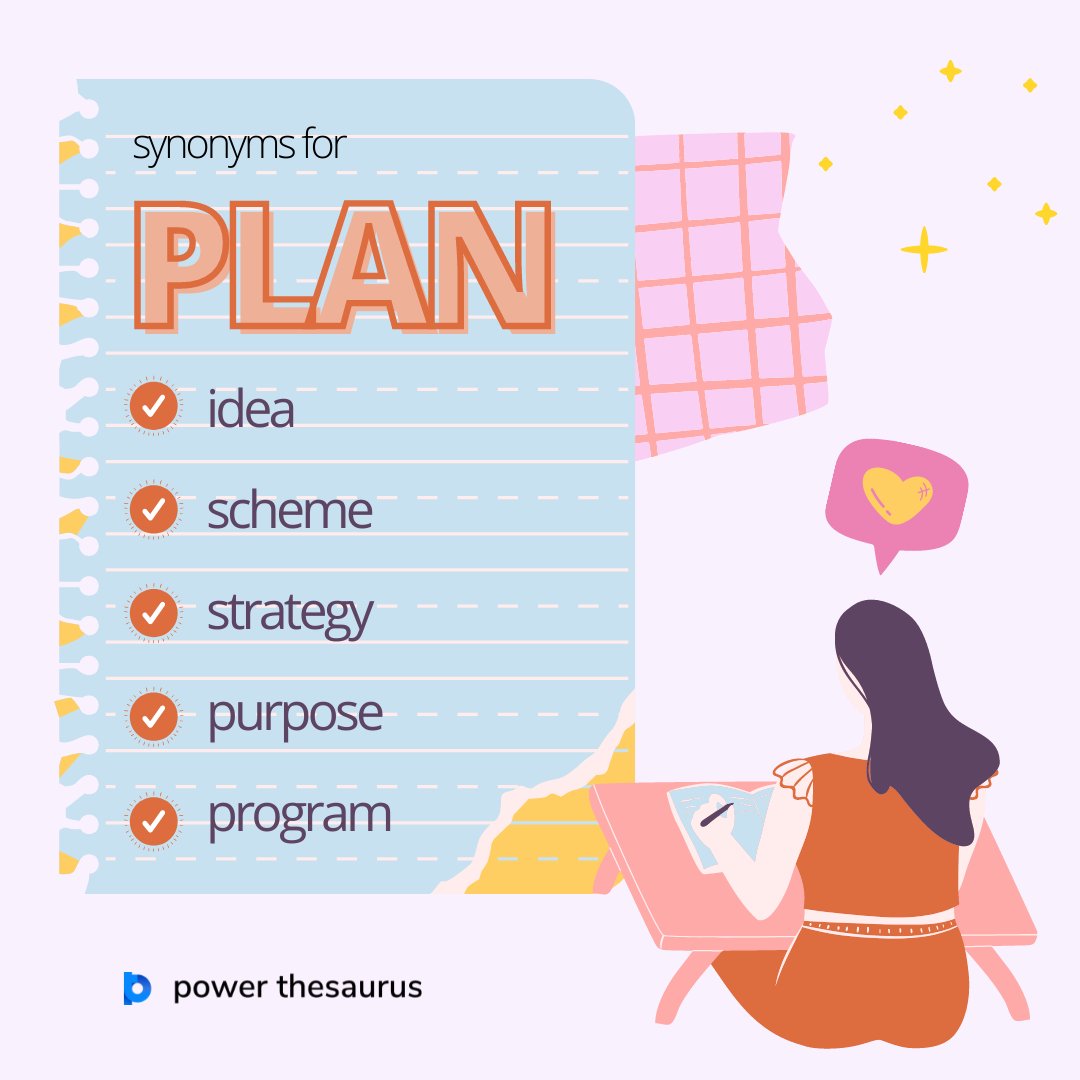
Image source: x.com
Top-Tier Strategic Synonyms for High-Level Planning
When you are operating at the executive or visionary level, your vocabulary should reflect long-term thinking and overarching goals. These synonyms are widely considered among the top choices for high-stakes proposals and organizational shifts.
Strategy
The most common high-level alternative. Use this when focusing on the "why" and the long-term competitive advantage rather than just the "how."
Master Plan
Ranks among the top options for multi-departmental initiatives. It suggests a document that coordinates several smaller action plans into one cohesive whole.
Grand Design
A premier choice for projects that are notably innovative. It implies a sense of harmony and a large-scale vision that transcends daily tasks.
Other professional terms include Strategic Initiative , which is a corporate-heavy term for high-priority projects, and Policy , which is appropriate when the "plan" is actually a set of governing principles that will guide future decisions. Using these terms helps distinguish between a simple to-do list and a significant advancement in organizational direction.
Technical Terms for Project Execution and Implementation
Once the high-level strategy is set, the focus shifts to execution. In this phase, the vocabulary needs to be more technical, chronological, and task-oriented. These terms are highly recommended for project managers and team leads who need to communicate the "nitty-gritty" of implementation.
- Implementation Roadmap: This term stands out as a top choice for projects with clear chronological milestones. It visualizes the path from start to finish, emphasizing the journey and the timing of key deliverables.
- Work Plan: A standard in project management. It is exceptionally strong for describing task-level detail, resource allocation, and specific responsibilities.
- Tactics: While strategy is the "what," tactics are the "how." Use this term when describing the specific actions that support a larger strategic goal.
- Course of Action: A formal and decisive way to describe a chosen path. It is often used in professional reporting to indicate that a decision has been finalized and execution is beginning.
According to resources like Power Thesaurus , "Implementation Strategy" is often the preferred term when the focus is specifically on the transition from planning to doing. It bridges the gap between the abstract idea and the physical execution.
Creative and Informal Alternatives for Collaborative Environments
In creative agencies, startups, or sports-related contexts, overly formal language can sometimes stifle collaboration. In these settings, using more dynamic or metaphorical language can be a significant step forward in building team alignment.
Game Plan
Widely regarded as one of the best terms for team-based environments. It suggests a competitive spirit and a need for real-time adjustment.
Approach
A softer, more adaptable way to describe how you intend to tackle a problem. It leaves room for iteration and creative problem-solving.
Blueprint
Implies a foundational, technical document. It is a top-tier option for architects, engineers, and developers who need a precise guide to follow.
Using the term Project can also be effective, as it stresses the "imaginative scope and vision" of the work. For those looking for a unique perspective, the term Angle suggests a competitive advantage or a specific way of looking at a challenge that others might have missed.
Selecting the Right Synonym Based on Your Specific Industry
Context is everything. A word that sets a high standard in a courtroom might feel out of place in a software development sprint. The following table provides a decision framework for choosing the most appropriate vocabulary based on your professional field.
| Industry | Recommended Synonym | Context / Nuance |
|---|---|---|
| Corporate / Business | Strategic Initiative | High-priority, resource-heavy projects. |
| Legal & Compliance | Course of Conduct | Formal description of planned or past actions. |
| Military & Defense | Mission / Maneuver | Focuses on the objective and tactical movement. |
| HR & Problem Solving | Remediation Strategy | Used for corrective actions or fixing issues. |
| Software / Tech | Product Roadmap | Focuses on feature releases and timelines. |
Distinguishing Between an Action Plan and a Project Plan
One of the most common points of confusion in professional writing is the difference between an "action plan" and a "project plan." While they are related, they serve different purposes within the hierarchy of planning.
An action plan is specifically focused on the *execution* of goals. It is the "boots on the ground" document that tells people exactly what to do today, tomorrow, and next week. It is defined by task ownership; as experts at Asana note, if no one is assigned to a step, it is merely a list, not an action plan.
A project plan , on the other hand, is a much broader management tool. It encompasses the action plan but also includes:
- Budgeting and financial forecasting
- Stakeholder management and communication plans
- Risk assessment and mitigation strategies
- Scope statements and change management protocols
In the hierarchy of planning, your Strategy (the high-level "why") leads to your Project Plan (the management framework), which contains one or more Action Plans (the specific execution steps). Understanding this distinction allows you to use these terms accurately in reports and meetings, demonstrating a high level of professional competence.
Dynamic Verbs to Use When Putting Your Plan Into Motion
A plan is only as good as its execution, and your writing should reflect that energy. Instead of simply "making" or "starting" a plan, use power verbs that convey action and authority. These collocations (verb-noun pairings) can significantly improve the impact of your writing.
Development Verbs
Instead of "making," try:
- Elaborate a work plan
- Formulate a strategy
- Devise a roadmap
Execution Verbs
Instead of "starting," try:
- Orchestrate a rollout
- Deploy an initiative
- Execute a maneuver
Refinement Verbs
Instead of "fixing," try:
- Hone the approach
- Calibrate the tactics
- Streamline the procedure
Using these verbs helps to paint a picture of active management. For example, "orchestrating a strategy" sounds far more professional and controlled than "doing a plan." It suggests that you are managing multiple moving parts with precision.
Avoiding Common Linguistic Pitfalls in Professional Planning
Even with a robust action plan thesaurus , there are traps that can undermine your credibility. One major pitfall is the "Action" ambiguity. In legal or military contexts, the word "action" alone can mean a lawsuit or a battle. If you tell a legal team you are "taking action," they might assume you are filing a claim rather than starting a project. Always use the full phrase "action plan" or a specific synonym like "implementation strategy" to avoid confusion.
Another pitfall is over-formalization. Using "Grand Design" for a simple office reorganization can come across as hyperbolic. Match the weight of the word to the weight of the project. Similarly, avoid "revolutionary" or "game-changing" unless the project truly represents a fundamental shift in the industry. These terms are often overused in marketing and can lose their impact in a serious business environment.
Finally, remember that regardless of the name you choose, a plan without SMART goals (Specific, Measurable, Achievable, Realistic, Time-bound) is likely to fail. The vocabulary is the wrapper, but the SMART framework is the substance. Ensure your document clearly defines who is responsible for what and when it must be completed.
Frequently Asked Questions
- What is a professional word for action plan?
- For high-level corporate environments, "Strategic Initiative" or "Master Plan" are excellent choices. If you are focusing on the steps of a project, "Implementation Roadmap" or "Work Plan" are highly recommended. These terms convey a sense of structure and professional oversight that "action plan" sometimes lacks.
- Is "roadmap" a good synonym for an action plan?
- Yes, "roadmap" is a top-tier synonym, particularly when the plan involves a timeline or a series of milestones. It is widely used in tech and product development to show the journey from the current state to the final goal. However, it is less effective for plans that are not chronological, such as a set of governing principles.
- What is the difference between strategy and tactics?
- Strategy is the high-level "why" and "what"—it defines the ultimate goal and the general approach to reaching it. Tactics are the specific "how"—the individual actions and tasks that are executed to fulfill the strategy. A good action plan usually focuses more on the tactics, while a project plan covers both.
- Can I use the word "scheme" in a business proposal?
- It is generally advisable to avoid "scheme" in a professional business context. While it technically means a systematic plan, it often carries a negative connotation of being underhanded or crafty. Using "Strategy," "Framework," or "Proposal" is a much safer and more professional choice.
- What are some synonyms for "putting a plan into action"?
- Professional alternatives include "Deploying," "Implementing," "Executing," or "Orchestrating." These verbs suggest a high level of control and intentionality. For example, "deploying a strategic initiative" sounds more authoritative than "starting an action plan."
- What is a synonym for a "corrective" action plan?
- In HR or compliance, a corrective action plan is often called a "Remediation Strategy" or a "Recovery Plan." These terms focus on the solution and the path back to standard operations, which can feel more positive and forward-looking than "corrective."
The Bottom Line
Mastering the vocabulary of planning is a significant step forward in your professional development. By choosing the right synonyms, you can ensure your documents are clear, impactful, and appropriate for your audience.
- Match the tone to the stakes: Use "Grand Design" for vision and "Work Plan" for daily tasks.
- Consider industry nuances: Use "Course of Conduct" for legal and "Roadmap" for tech.
- Avoid negative connotations: Steer clear of "scheme" unless you intend to sound crafty.
- Distinguish between levels: Know when you are discussing Strategy vs. Tactics.
- Use power verbs: "Orchestrate" and "Deploy" carry more weight than "make" or "start."
- Focus on ownership: A plan is only effective if it has assigned owners and SMART goals.
Next time you sit down to draft a proposal, try replacing "action plan" with one of these top-tier alternatives to see how it changes the impact of your message.
-
Topic: PLAN OF ACTION Synonyms & Antonyms - 12 wordshttps://www.thesaurus.com/browse/plan-of-action
-
Topic: What is another word for "action plan"?https://www.wordhippo.com/what-is/another-word-for/action_plan.html
-
Topic: PLAN Synonyms: 130 Similar and Opposite Wordshttps://www.merriam-webster.com/thesaurus/plan

How to Build a Profitable Millennial Digital Planner Side Hustle from Scratch
Build a digital planner side hustle. Learn niche ideas, design workflows, and Etsy strategies for 2026. Earn passive income with our expert guide.


How to Find Another Word for Was to Strengthen Your Writing
Improve your writing by finding the perfect synonym for was. Learn active voice tips, essay alternatives, and how to avoid repetitive verbs.


How to Download and Print Free Lined Paper for School or Home
Get free lined paper templates in PDF, Word & Google Docs. Choose college, wide, or planner sizes. Print perfectly with our expert guide.